
An Emblem of America: What These Old Images Really Show Us
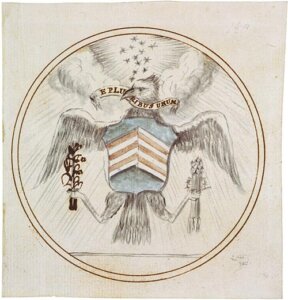
For most people, the first “official” symbol of the United States is the Great Seal — the bald eagle, arrows, olive branch, and the motto E Pluribus Unum, adopted in 1782.
For most people, the first “official” symbol of the United States is the Great Seal — the bald eagle, arrows, olive branch, and the motto E Pluribus Unum, adopted in 1782.
But long before Uncle Sam and even while the Great Seal was still new, publishers in Europe were already printing images that claimed to show “An Emblem of America.”
These prints were not official government seals. They were popular pictures sold to the public — and that makes them even more revealing. They show how the land called “America” and the people of this land were understood at the time.
On this page, we’re going to look closely at three of those images:
An Emblem of America– dark-skinned figure standing alone
An Emblem of America– white woman with two dark-skinned children
An Emblem of Africa– dark-skinned figure representing the African continent
When you put them side by side, a pattern appears that speaks directly to Native Black American history, identity erasure, and reclassification.
A Dark-Skinned “Emblem of America”
A single dark-skinned figure stands in a lush landscape with palms, water, and mountains. She carries a bow and arrow, wears feathers and animal skin, and is decorated with beads and jewelry.
Art historians usually call this the “Indian princess” or “Indian queen” — a stock character European artists used to personify the Americas. The standard explanation says:
The feathers and weapons = “wilderness” and “savageness”
The tropical background = “exotic New World”
The dark skin = just a symbol for “non-European”
In other words, we’re told this is only an allegory, not a reflection of real people.
But there’s a problem with that explanation:
The skin tone is deeply dark, not the “copper” or “tawny” tone often described for many Indigenous groups in North America.
The facial features and build are close to what we would now recognize as Negro features.
If an artist were simply sketching a Native person they saw in the northern colonies, the figure would not look like this. Even within the rules of “allegory,” something else is peeking through: a memory of dark-skinned people tied to this land.
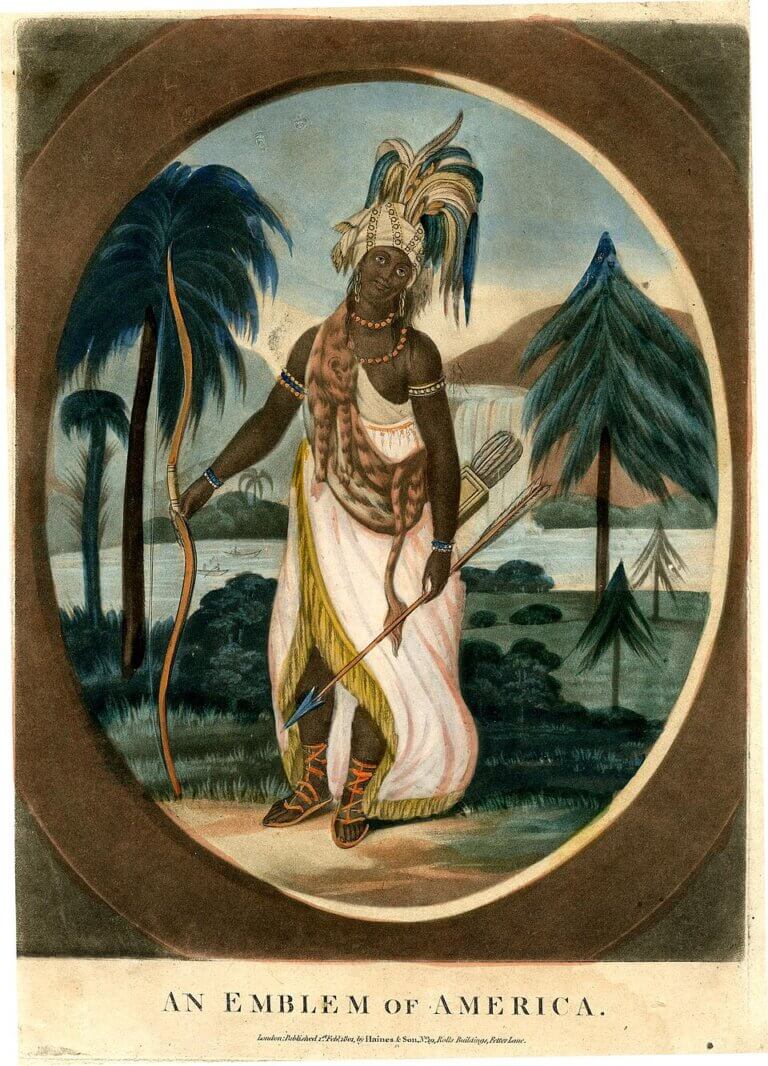
*“An Emblem of America,” late 18th century. A dark-skinned, feather-crowned archer stands alone in a lush American landscape, reflecting an earlier era when the continent itself was personified by a dark-skinned figure.
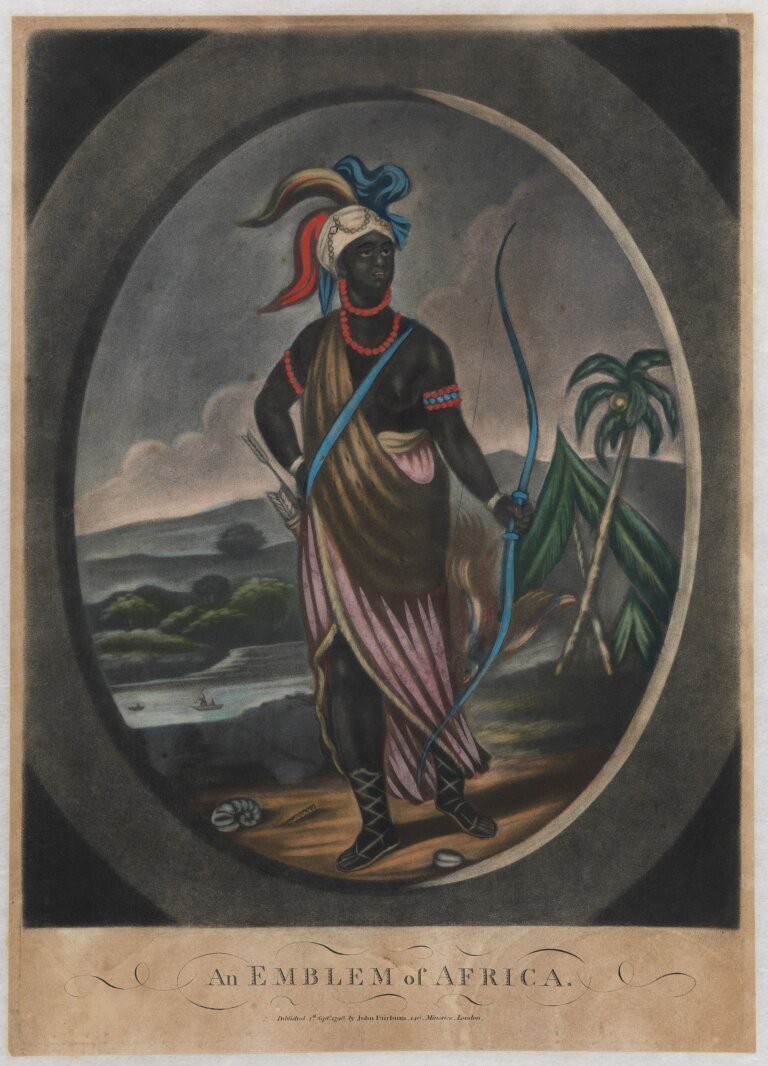
*“An Emblem of Africa,” late 18th–early 19th century. A dark-skinned figure represents Africa, allowing us to compare how artists distinguished between the continents while still using dark-skinned personifications for both.
“An Emblem of Africa” – The Control Image
Next, look at the third image: “AN EMBLEM OF AFRICA.”
Here we see another dark-skinned figure with a bow, arrows, feathers, and jewelry. The landscape is different, the clothing is different, and the styling is different.
This is important:
The artist clearly knew how to distinguish one continent from another.
Africa and America are not drawn as the same generic “dark savage.”
Each has its own costume, setting, and feel.
That means the dark-skinned “Emblem of America” cannot be brushed off as a lazy mix-up with Africa. The publisher chose to print two separate dark-skinned emblems — one for Africa and one for America.
So the real question becomes:
Why did “America” ever have a dark-skinned emblem at all?
The Switch – Columbia and the Dark-Skinned Children
Now look at the first image above — another print titled “An Emblem of America.”
In this version, we see:
A white, classical woman (often called Columbia or Liberty) standing on stone steps, holding an early American flag.
Two dark-skinned children with feathers and simple cloth stand beside her, positioned lower, on the ground.
A vine or column shows portraits of white leaders — the “founding fathers.”
This is the visual shift in action:
The dark-skinned figure of America has been demoted. In earlier prints, she stood alone as “America.”
Now, the white woman is the nation, and the dark-skinned children are reduced to symbols of the land, the past, or the “savages” to be civilized.
The portraits of white statesmen anchor who is allowed to be the face of the new republic.
This is not a harmless change in style. It is a political and spiritual rebranding.
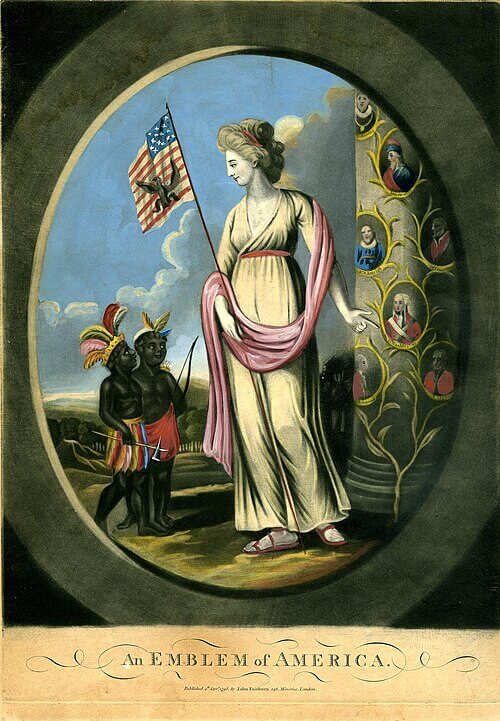
*“An Emblem of America,” c. 1800–1801. A white Columbia figure holds the early U.S. flag while two dark-skinned children in feathered dress stand at her feet — a visual rebranding of who is allowed to represent “America.”
From Emblem to Erasure: What These Images Reveal
When we trace the sequence:
Dark-skinned Emblem of America standing alone
Dark-skinned Emblem of Africa standing alone
White Columbia as America with dark-skinned children at her feet
we can see three layers at work:
1. Identity Erasure
Identity erasure is the process of denying, hiding, or rewriting who a people truly are.
In this case, the earliest personifications of America were dark-skinned. Over time, that image was replaced by a white figure, and the dark-skinned presence was pushed down into the background — or turned into children, servants, or scenery.
2. Historical Erasure
Historical erasure is when the roles, presence, and experiences of a people are removed or minimized in the historical record.
These prints come from the late 1700s and early 1800s — the same era this land was being mapped, claimed, and renamed. The fact that a dark-skinned figure could ever stand as “America” tells us that Europeans did see and record darker peoples tied to this land.
Later, as the United States tried to align itself with Europe and whiteness, those images disappeared from the center of the story.
3. Symbolic Annihilation
In media studies, symbolic annihilation is what happens when a group is ignored, underrepresented, or portrayed only in narrow roles. Over time, this sends the message that the group doesn’t really matter — or was never there in the first place.
By shifting the emblem of America from a dark-skinned figure to a white Columbia, and shrinking the darker figures to children at her feet, the visual message becomes:
This land may have dark people on it, but they are not America. She is.
For Native Black Americans, this is more than artwork. It is a receipt of how our image was reshaped, downgraded, and overwritten.
Beyond “Out of Africa”: Reading the Image for Ourselves
Mainstream art history often explains these prints as “just allegories” that blur Native and African traits into a single stereotype.
But when we look with our own eyes — and with our own ancestral memory — a different reading appears:
The artist and publisher could tell the difference between Africa and America.
They chose to print a dark-skinned emblem for each continent.
Later, the American emblem was recast as white, and the darker figures were visually subordinated.
For many of us, this lines up with what we already know in our bones:
That Black people were here before the neat textbook timeline says we were.
That Native Black Americans, American Negroes, and other Indigenous Black populations were systematically reclassified — into “Negro,” “colored,” “African American,” “savage,” “slave,” or “immigrant” — so that our rootedness to this land could be denied.
These images do not settle every historical debate, but they visibly expose the moment of rebranding — when America chose a white face and tried to push our image out of its own story.
At Trace Thy Roots, we don’t look at prints like these as cute vintage art. We treat them as evidence. They are visual testimonies that support what our elders have been saying for generations:
We didn’t just arrive. We were already here.
Key Terms Used on This Page
Identity Erasure – Systematically denying or hiding a group’s true identity or origins.
Historical Erasure – Removing or minimizing a group’s presence and contributions from the historical record.
Symbolic Annihilation – When a group is ignored, downgraded, or only shown in narrow roles in media and culture, sending the message that they don’t truly belong.
