
Historical Articles

Walter Plecker. the Architect of Paper Genocide

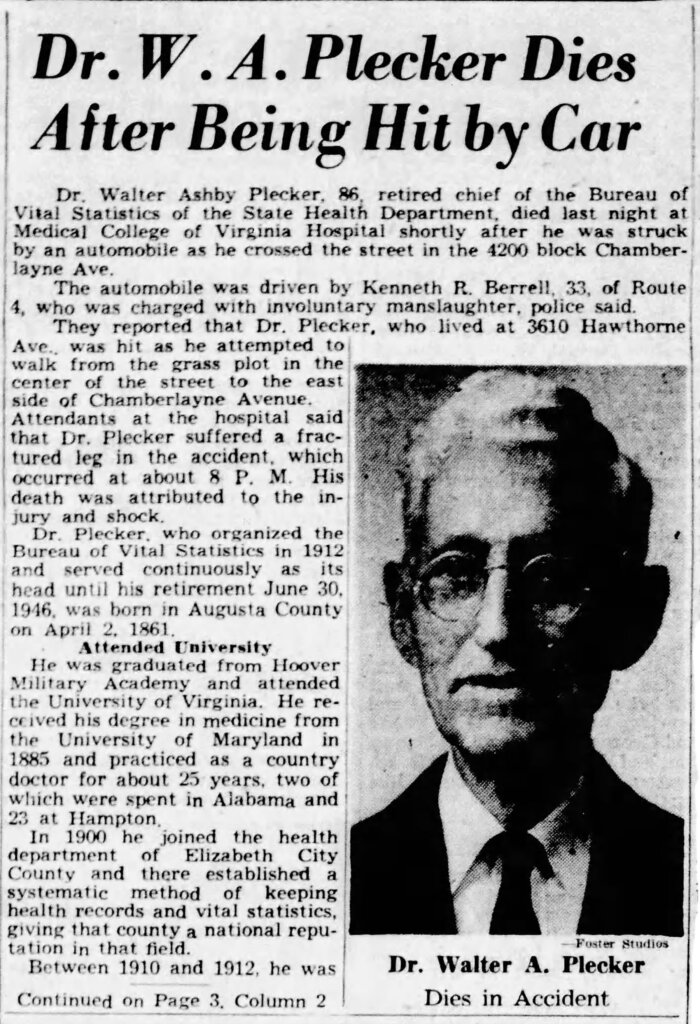
Bitter Sweet Truth: When the Architect of Paper Genocide Became a Headline June 10, 2024 By T’Malkia Zuri [Walter Plecker Obituary. Richmond Times-Dispatch Richmond, Virginia · Sunday, August 03, 1947] There is something bitter sweet about reading the obituary of Walter Ashby Plecker. Not because his death brought justice—it did not.But because history finally fixed his name to the record he tried so hard to erase. Plecker was not a footnote. He was an architect. As the longtime registrar of Virginia’s Bureau of Vital Statistics, he oversaw what can only be described as one of the largest paper genocides in American history. Through policies, letters, and administrative force, he worked relentlessly to reclassify Indigenous people as “Negro,” collapsing entire tribal identities into a single racial category designed to erase land claims, lineage, and legal standing—efforts publicly reported at the time, including a 1929 newspaper account documenting his push to have the Chickahominy Tribe classified as “Negro” for the federal census. This was not accidental.This was policy. [Virginia Indians Reclassified. Evening Herald Courier Bristol, Tennessee · Tuesday, September 10, 1929] Reclassification Was a Weapon Plecker understood something deeply dangerous:records create reality. By controlling birth certificates, marriage licenses, death records, and census classifications, he controlled who the state said you were. And once the paper changed, the law followed. Families who had lived on their land for generations—documented as Indian, Native, or tribal—were suddenly redefined with a pen stroke. Not because their ancestry changed, but because the state decided it was inconvenient. Reclassification stripped people of: Tribal recognition Land inheritance Legal identity Community continuity And once the paper trail was altered, proving the truth became an uphill battle that many families are still fighting today. [Walter Plecker Racial Studies. Richmond Times-Dispatch Richmond, Virginia · Thursday, May 16, 1946] The Effects Did Not End With Him This is why Plecker’s work still matters. When people today struggle to trace their lineage…When families find “mulatto,” “colored,” or “Negro” replacing tribal identifiers…When Indigenous Black Americans are told their ancestry is “unverifiable”… They are running into his shadow. Reclassification didn’t just erase people in the past—it destabilized their descendants’ ability to prove who they are in the present. That is the bitter part. The Sweet Part Is This: The Records Still Exist Despite everything Plecker tried to destroy or overwrite, he failed in one crucial way. The contradictions are still there.The earlier records still exist.The newspapers still speak.The land deeds, court cases, church registers, and family Bibles still tell the truth. And now, people are reading them again. What was once buried is being compared.What was once denied is being documented.What was once erased is being reclaimed. Reclassification Is Not History — It Is Ongoing We must be clear: reclassification is not a closed chapter. It continues today through: Census definitions DNA misinterpretation Cultural replacement Identity dilution The dismissal of documented lineage in favor of narrative Understanding Plecker is not about dwelling on the past—it is about recognizing a system that never fully ended. Remember This Walter Plecker died.His policies outlived him. But so did the truth. And every time someone traces their roots, challenges a record, or restores a family name to its rightful place, that truth pushes back against the paper genocide he helped engineer. That is the bitter sweet reality. History may delay accountability—but it does not forget. Uncategorized Dump Empress T’Malkia ZuriJanuary 24, 2026 Genealogy, Historical Articles, Matrix News Reclassification and the Names They Called Us Empress T’Malkia ZuriJanuary 23, 2026 Genealogy How to Begin Black American Genealogy Research Empress T’Malkia ZuriJanuary 22, 2026 Genealogy, Historical Articles Walter Plecker. the Architect of Paper Genocide Empress T’Malkia ZuriJanuary 21, 2026 Historical Articles When a Name in the Bible Meant Everything Empress T’Malkia ZuriJanuary 21, 2026
Walter Plecker. the Architect of Paper Genocide Read More »

When a Name in the Bible Meant Everything

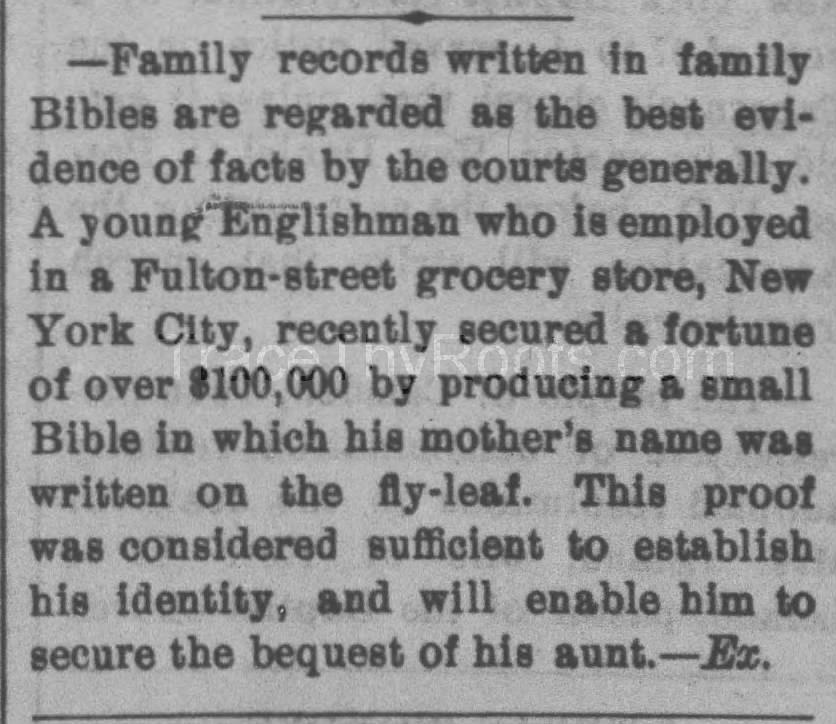
When a Name in a Bible Meant Everything: Why Tracing Your Roots Still Matters September 6, 2024 By T’Malkia Zuri Why Tracing Your Roots Is an Act of Protection Genealogy is not about nostalgia. It is about defense. In earlier eras, a Bible entry could secure a fortune. Today, documentation can: Protect cultural identity Prevent historical erasure Challenge false narratives Establish rightful belonging When genealogy is dismissed as unnecessary or “old-fashioned,” its purpose is misunderstood. Genealogy has always been a shield. Genealogy Was Never About Curiosity — It Was About Proof For generations, genealogy served a practical and necessary purpose: Establishing identity Securing inheritance Proving lineage Protecting land, name, and legal standing Long before centralized record systems, families preserved their truth in Bibles, ledgers, newspapers, deeds, and court filings. These records carried legal weight because they were created close to the events themselves—by people who were present for births, deaths, marriages, and kinship ties. This is especially important when discussing Native Black American history. Our ancestors documented themselves. The issue is not a lack of records—it is that many people have never been taught where to look or how to read them. [“Family records written in family Bibles regarded as the best evidence of facts by the courts generally.” The Baptist and Reflector (Nashville, Tennessee), November 11, 1897.] There was a time when ancestry was not debated on social media or guessed through DNA percentages. It was documented. The newspaper clipping above makes something unmistakably clear: family records written in Bibles were regarded by American courts as the best evidence of identity. Not opinions. Not assumptions. Not vibes. Records. In the case cited, a young man in New York City secured a fortune—more than $100,000—because a small family Bible contained his mother’s name, handwritten on the flyleaf. That single entry was enough to establish who he was, where he came from, and his rightful legal claim. That is not folklore. That is law, history, and documentation working together. Why Documentation Matters Now More Than Ever We are living in a time when identity is being diluted by repetition rather than evidence. Increasingly, individuals—particularly immigrants—publicly claim Indigenous American ancestry without: Tribal enrollment Historical presence in U.S. records Land allotments Freedmen or pre-1900 census ties Community continuity In many cases, these claims rest on oral assertions or distant DNA interpretations, not contemporaneous documentation. But history does not work backwards. You do not become Indigenous to a land because you arrived later and adopted its language, culture, or politics. Indigeneity is established through presence, continuity, and record. Records Tell the Story That Claims Cannot Primary-source records—newspapers, land deeds, probate files, court cases, tax rolls, and city directories—tell us: Who was already here Who owned land Who built towns Who paid taxes Who was classified, reclassified, or erased When these records are examined honestly, a consistent truth emerges: Native Black Americans were documented on this land long before many modern claimants arrived. That is not an opinion. It is a paper trail. The Difference Between Heritage and Assertion Everyone has a heritage. Not everyone has a documented lineage tied to this land. Claiming Indigenous American ancestry without records does not strengthen history—it weakens it. It replaces evidence with assumption and turns lived experience into abstraction. This is why tracing your roots matters. Not for validation—but for clarity. [World’s Best Selling Book is the Bible. South-Side News Chicago, Illinois · Friday, April 10, 1925] Were Family Bibles Ever Targeted in the United States? There has never been a single federal law requiring all U.S. citizens to surrender their Bibles. That fact is often used to dismiss the idea that religious and family records were intentionally targeted. But the absence of a nationwide statute does not mean these records were protected. In practice, family Bibles and other genealogical records were frequently confiscated, restricted, invalidated, or destroyed through local and institutional systems, including: Colonial and territorial authorities Slaveholding systems and plantation governance Local courts and municipal enforcement Missionary-led “civilizing” and assimilation programs State- and church-controlled record replacement systems These actions did not require a federal mandate. They operated through custom, coercion, enforcement, and circumstance, often under the guise of order, conversion, or property control. Family Bibles were not merely religious texts. They were legal documents—containing handwritten records of births, marriages, deaths, and kinship that once carried weight in American courts. Because of that, they posed a problem. When identity needed to be erased, altered, or reassigned, family-held documentation became a liability to those in power. Removing or invalidating these records made it easier to sever lineage, dissolve inheritance claims, and reclassify people outside their own recorded history. So while the United States never issued a blanket command to “turn in your Bible,” the historical reality is clear: Wherever control over identity was required, family Bibles were vulnerable—and often lost. That loss was not accidental. And its effects are still being felt today. Uncategorized Walter Plecker. the Architect of Paper Genocide Empress T’Malkia ZuriJanuary 21, 2026 Historical Articles When a Name in the Bible Meant Everything Empress T’Malkia ZuriJanuary 21, 2026 Matrix News This Ain’t Our Fight: Why Black Panther History Is Being Misused Empress T’Malkia ZuriJanuary 20, 2026 Matrix News Trump Says Black Americans Built America Empress T’Malkia ZuriJanuary 16, 2026 Press Releases Press Release for We Built This Beep T'Malkia ZuriJanuary 15, 2026

When a Name in the Bible Meant Everything Read More »

Scroll to Top