Foundational Black American (FBA): Lineage or Cult?
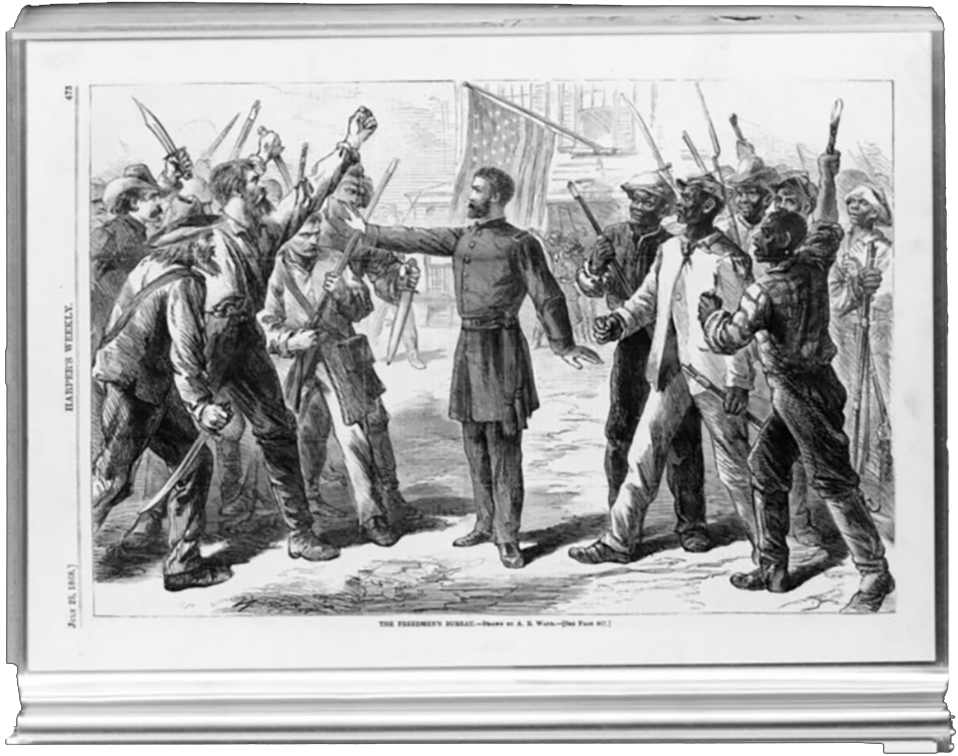
[The Freedmen’s Bureau, Drawn by A.R. Waud. Harper’s Weekly, 1868. Library of Congress] Foundational Black American (FBA): Lineage or Cult? A few years ago, I was watching content creator Tariq Nasheed, who was discussing how Black Americans are routinely grouped into crime statistics alongside immigrants who arrived in the United States long after the foundational population was already established. He pointed out a pattern many of us have observed for decades: when something negative is reported, the media collapses all so-called “Black” people into a single, undifferentiated group — regardless of origin, lineage, or historical context. His argument was straightforward: each group should be responsible for itself, and that responsibility begins with accurate identity. On multiple occasions, Nasheed used the term “Native Black American,” crediting its popular use to Dr. Claude Anderson, a well-known author and political economist whose work has long focused on Black history, economic development, and the rebuilding of Black American communities through self-sufficiency and institutional awareness. As the term Native began circulating, callers flooded Nasheed’s broadcasts claiming they too were native to America. His response was telling: the language was not strong enough. He argued that Black Americans needed an identifier that was more precise — something that could not be easily appropriated or “crowbarred” into by those without the lineage. Out of that moment, the term Foundational Black American (FBA) was introduced to me — intended to describe Indigenous Americans who had been historically reclassified as Negro, Colored, Black, African American, and similar labels over time. Now, in 2026, a new narrative has emerged. FBA is increasingly being described as a cult, with accusations that Nasheed himself is its leader. From the outside — particularly to those not of the American lineage — I understand how it can be framed that way. Any group that insists on delineation in an era obsessed with sameness is bound to face resistance. That said, I want to be clear about my own position. I do not personally use the identifier FBA. Not because I reject the lineage — I am very much of it — but because I am exhausted by the constant cycling of names. In my lifetime alone, I have been identified as Black, African American, and Black American. Each shift promised clarity and instead delivered confusion. I simply do not have room for another identifier, though I do not dismiss it either. One thing I do appreciate about the term FBA or Foundational Black American is that it was not forced upon us — unlike African American, which was publicly popularized by Rev. Jessie Jackson and politically assigned. What is notable is that many so-called African Americans are embracing the term FBA voluntarily and, in many cases, proudly. As long as native Black Americans are the ones agreeing to and defining the identifier themselves, I have no objection. This is a great sign that native Black Americans are ON CODE. What concerns me more is this: moving away from the term “African American” without replacing it with documented truth has caused real harm — especially considering that most of us may not be African by origin. Identity cannot survive on slogans or acronyms alone. Without records, land documentation, census data, newspapers, and contemporaneous evidence, any label — no matter how well-intended — will eventually be challenged, diluted, or redefined by others. That is where Trace Thy Roots stands apart. This blog is not here to promote movements, personalities, or identifiers. It exists to document, archive, and preserve the historical record of Indigenous Black Americans through primary sources — the only language history ultimately respects. Names may change. But records don’t. December 13, 2025 By T’Malkia Zuri Popular Posts All Posts Genealogy Historical Articles Matrix News Press Releases Foundational Black American (FBA): Lineage… January 25, 2026 How to Begin Black American… January 22, 2026 Walter Plecker. the Architect of… January 21, 2026 When a Name in the… January 21, 2026 Blog Category Genealogy Historical Articles Matrix News Press Releases The American Emblem Press Release for We Built This Beep January 15, 2026 | by T'Malkia Zuri We Built This [Beep] The Historical Receipts of Black American Visionaries, Builders, Farmers, and Founders For Immediate ReleaseTrace Thy Roots… Read More → Trump Says Black Americans Built America January 16, 2026 | by Empress T’Malkia Zuri Trump Says Black Americans Built America December 2, 2025 By T’Malkia Zuri A Statement Entered Into the Record In the… Read More → Dr. Claud Anderson PowerNomics : The National Plan to Empower Black America View more articles Matrix News Foundational Black American (FBA): Lineage or Cult? Empress T’Malkia ZuriJanuary 25, 2026 Genealogy, Historical Articles, Matrix News Reclassification and the Names They Called Us Empress T’Malkia ZuriJanuary 23, 2026 Genealogy How to Begin Black American Genealogy Research Empress T’Malkia ZuriJanuary 22, 2026 Genealogy, Historical Articles Walter Plecker. the Architect of Paper Genocide Empress T’Malkia ZuriJanuary 21, 2026 Historical Articles When a Name in the Bible Meant Everything Empress T’Malkia ZuriJanuary 21, 2026
Foundational Black American (FBA): Lineage or Cult? Read More »