
Bitter Sweet Truth: When the Architect of Paper Genocide Became a Headline
- June 10, 2024
- By T'Malkia Zuri
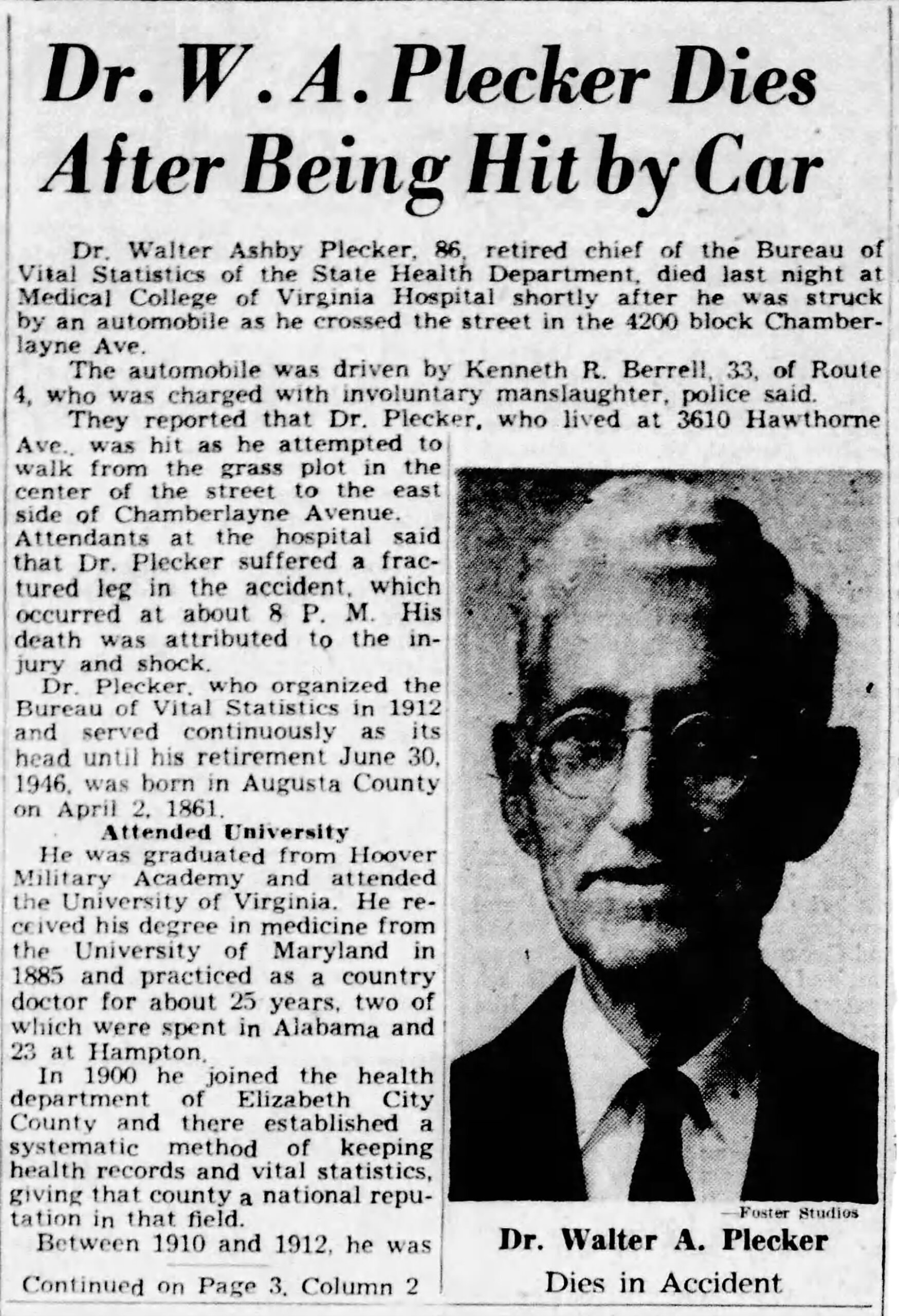
There is something bitter sweet about reading the obituary of Walter Ashby Plecker.
Not because his death brought justice—it did not.
But because history finally fixed his name to the record he tried so hard to erase.
Plecker was not a footnote. He was an architect.
As the longtime registrar of Virginia’s Bureau of Vital Statistics, he oversaw what can only be described as one of the largest paper genocides in American history. Through policies, letters, and administrative force, he worked relentlessly to reclassify Indigenous people as “Negro,” collapsing entire tribal identities into a single racial category designed to erase land claims, lineage, and legal standing—efforts publicly reported at the time, including a 1929 newspaper account documenting his push to have the Chickahominy Tribe classified as “Negro” for the federal census.
This was not accidental.
This was policy.
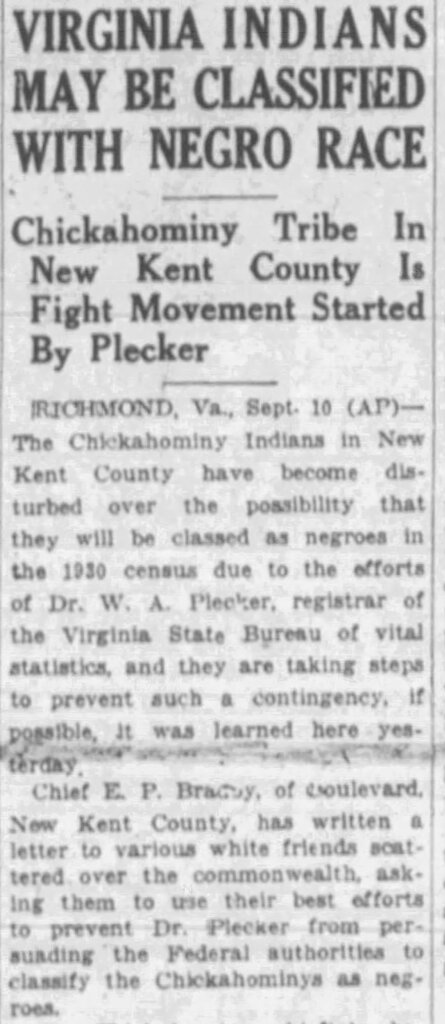
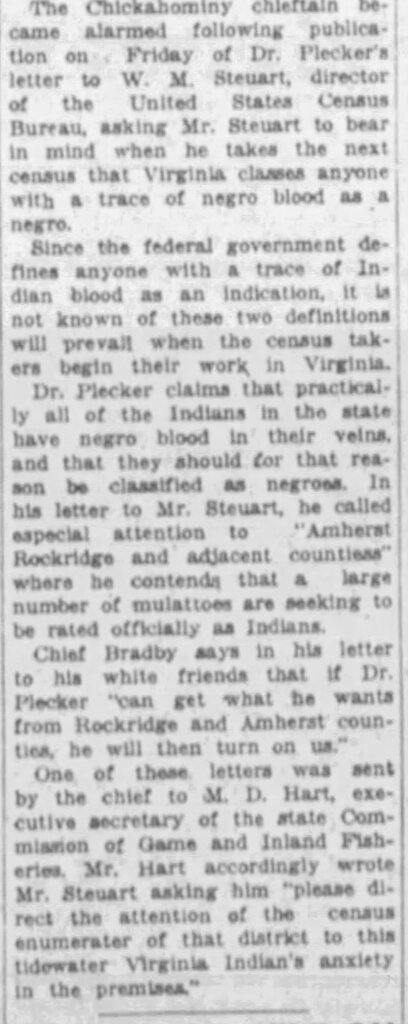
[Virginia Indians Reclassified. Evening Herald Courier Bristol, Tennessee · Tuesday, September 10, 1929]
Reclassification Was a Weapon
Plecker understood something deeply dangerous:
records create reality.
By controlling birth certificates, marriage licenses, death records, and census classifications, he controlled who the state said you were. And once the paper changed, the law followed.
Families who had lived on their land for generations—documented as Indian, Native, or tribal—were suddenly redefined with a pen stroke. Not because their ancestry changed, but because the state decided it was inconvenient.
Reclassification stripped people of:
Tribal recognition
Land inheritance
Legal identity
Community continuity
And once the paper trail was altered, proving the truth became an uphill battle that many families are still fighting today.
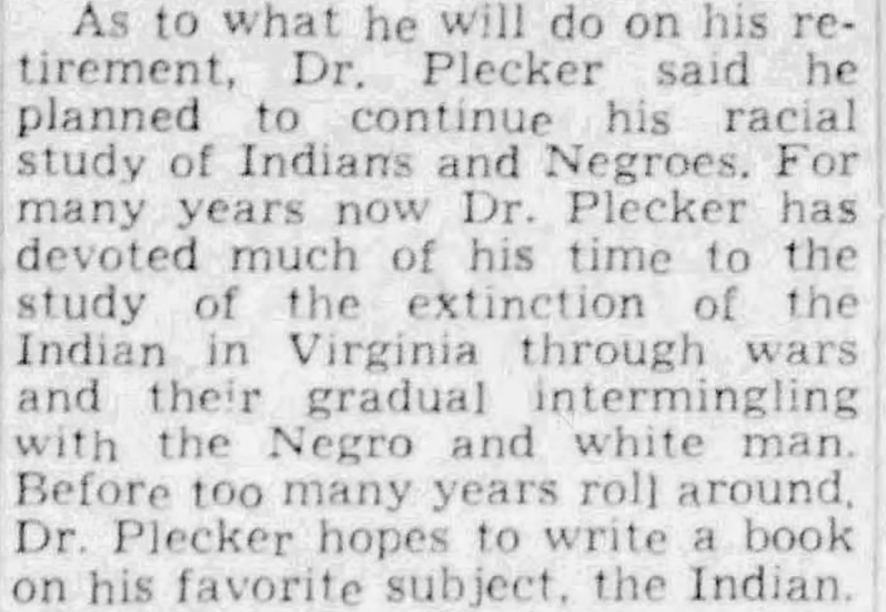
The Effects Did Not End With Him
This is why Plecker’s work still matters.
When people today struggle to trace their lineage…
When families find “mulatto,” “colored,” or “Negro” replacing tribal identifiers…
When Indigenous Black Americans are told their ancestry is “unverifiable”…
They are running into his shadow.
Reclassification didn’t just erase people in the past—it destabilized their descendants’ ability to prove who they are in the present.
That is the bitter part.
The Sweet Part Is This: The Records Still Exist
Despite everything Plecker tried to destroy or overwrite, he failed in one crucial way.
The contradictions are still there.
The earlier records still exist.
The newspapers still speak.
The land deeds, court cases, church registers, and family Bibles still tell the truth.
And now, people are reading them again.
What was once buried is being compared.
What was once denied is being documented.
What was once erased is being reclaimed.
Reclassification Is Not History — It Is Ongoing
We must be clear: reclassification is not a closed chapter.
It continues today through:
Census definitions
DNA misinterpretation
Cultural replacement
Identity dilution
The dismissal of documented lineage in favor of narrative
Understanding Plecker is not about dwelling on the past—it is about recognizing a system that never fully ended.
Remember This
Walter Plecker died.
His policies outlived him.
But so did the truth.
And every time someone traces their roots, challenges a record, or restores a family name to its rightful place, that truth pushes back against the paper genocide he helped engineer.
That is the bitter sweet reality.
History may delay accountability—but it does not forget.
